Abstract
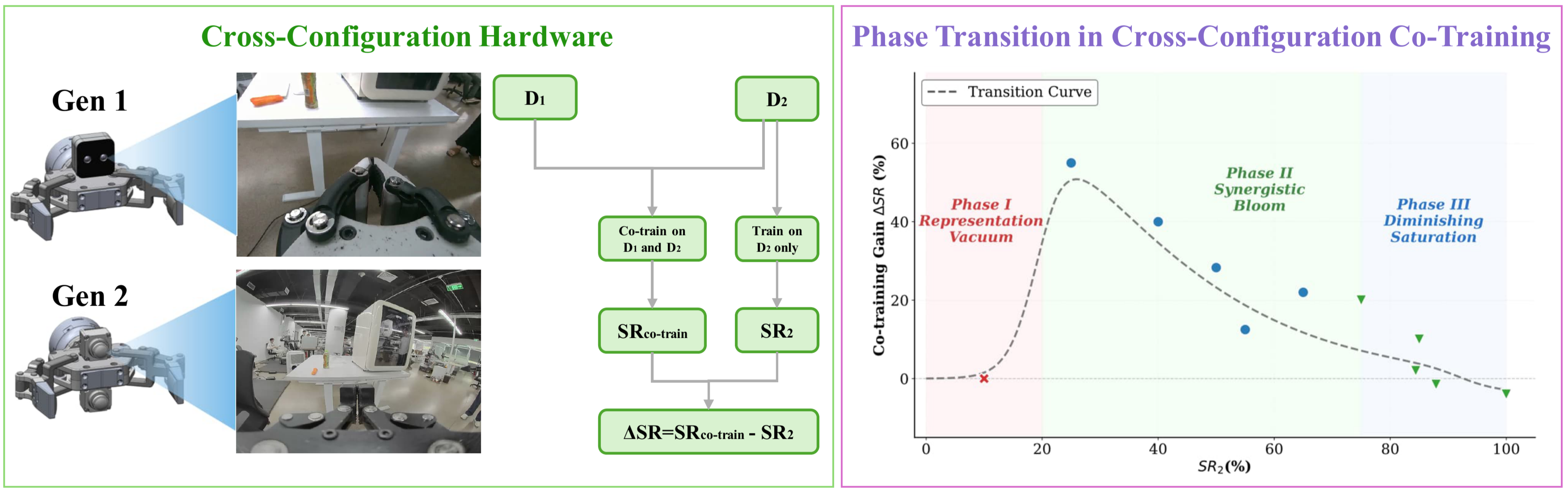
Robotic hardware evolves over time, but demonstration data is often tied to a specific sensor and actuator configuration. This raises a practical and underexplored question: when does legacy data begin to benefit an upgraded robot? We study this question on a wheeled humanoid platform across two hardware generations, where both the camera and gripper are changed while the overall morphology remains fixed. Contrary to the common assumption that more cross-configuration data is always helpful, we observe a grokking-like transition: legacy data remains ineffective until the upgraded configuration acquires a minimum level of task competence, after which co-training gains rise sharply before diminishing near saturation. We hypothesize that this task-dependent transition is governed by a transfer threshold and characterize the resulting three-phase pattern. Across real-robot manipulation tasks, we observe all three phases: no measurable benefit at low competence (10.0% → 10.0%), a sharp gain after crossing the threshold (23.3% → 86.7% on flower insertion), and diminishing returns at high competence (85.0% → 93.3% on pen insertion). We provide a theoretical account based on gradient alignment and residual policy uncertainty, and derive a phase-aware rule for deciding when to collect more new-hardware data and when to reuse legacy demonstrations. We further validate this three-phase pattern on a mobile dual-arm watering task, with results consistent with our predictions.
Key Results
(23.3% → 86.7%)
(8h → 1.5h)
(40.0% → 78.3%)
Key Contributions
- Emergent Three-Phase Transfer Pattern: We identify and statistically support that legacy data is ineffective at low target competence, highly beneficial at intermediate competence, and subject to diminishing returns near saturation.
- Theoretical Framework: We model this transition using a task-dependent transfer threshold τ(T) and provide a theoretical account based on gradient alignment, residual policy uncertainty, and domain adaptation.
- Phase-Aware Data Collection: We formulate a practical rule that collects new-hardware demonstrations until the transfer threshold is crossed, then introduces legacy data for co-training, reducing collection time from 8 hours to 1.5 hours on a held-out task.
Experimental Results
Real-Robot Manipulation Tasks
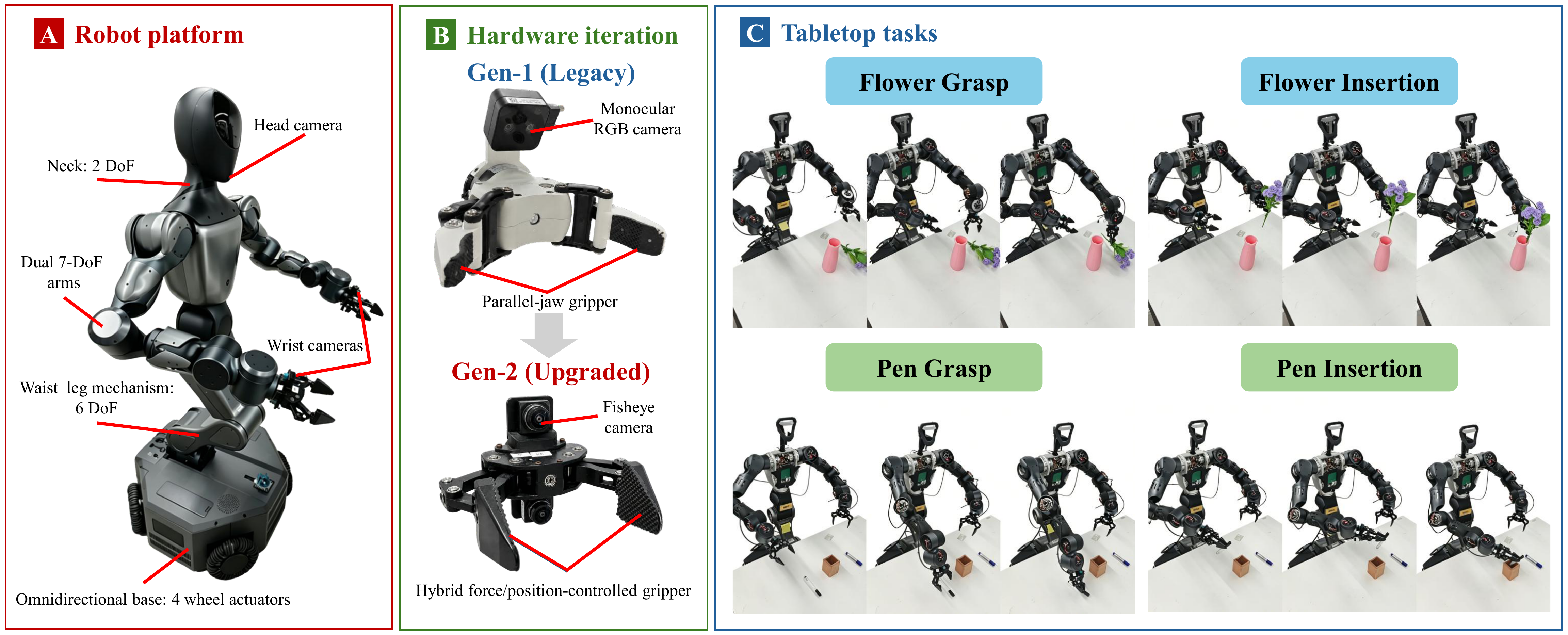
We begin with a suite of real-robot manipulation tasks on a wheeled humanoid platform, evaluated across two hardware generations that differ in both camera and gripper while keeping the overall morphology fixed. These tasks span a range of standalone success rates, from near-random to near-saturation, which lets us observe how the benefit of legacy data changes as the upgraded configuration becomes more competent.
The Emergent Three-Phase Pattern
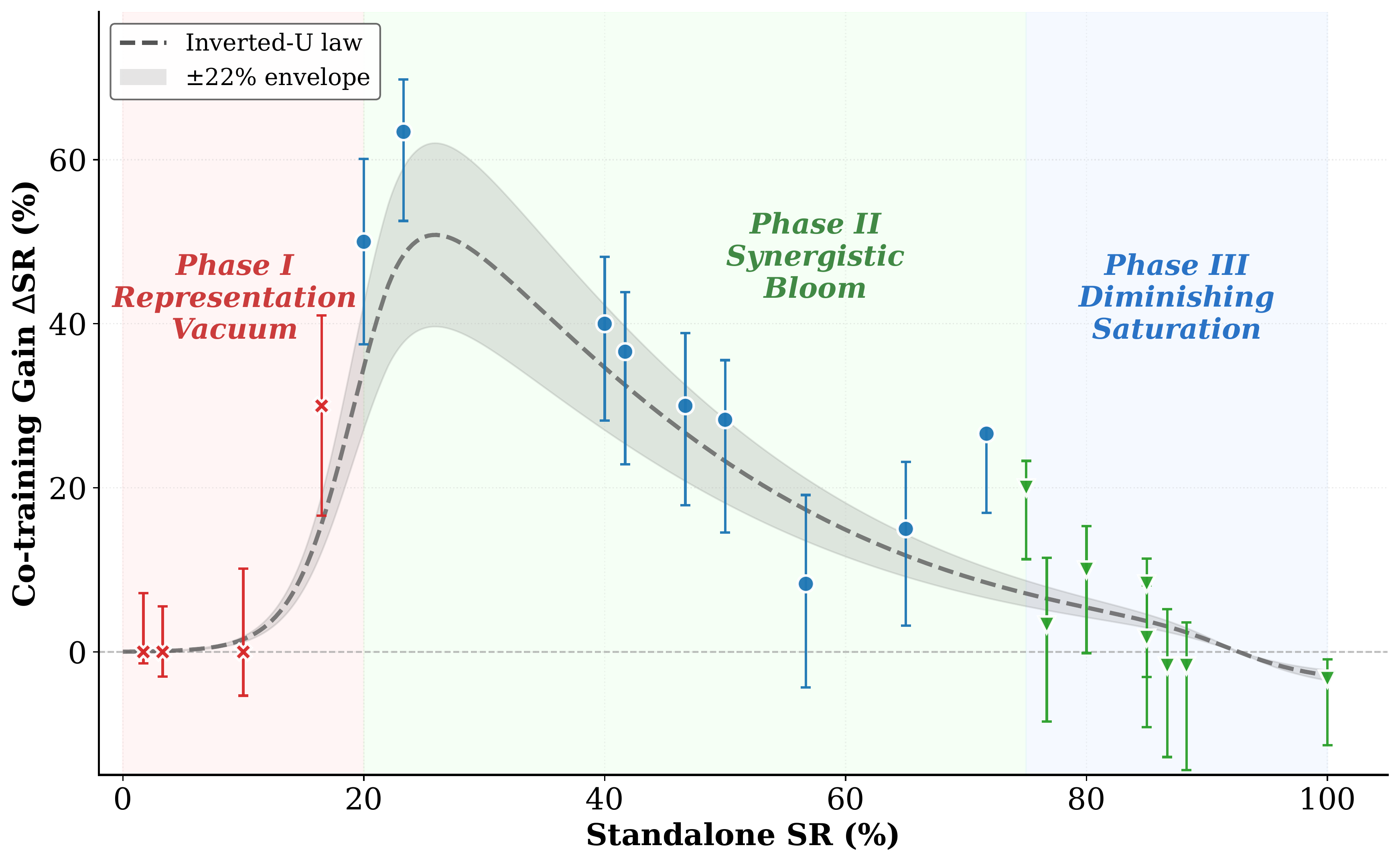
Aggregating results across these tasks reveals a consistent pattern. Plotting the co-training gain ΔSR against the standalone success rate SR₂ exposes three distinct phases: below the task-dependent transfer threshold τ(T), legacy data provides no measurable benefit; just above the threshold, it produces its largest gains; and near saturation, the returns diminish. This curve is the empirical backbone of our analysis and motivates the phase-aware data collection rule.
Validation: Mobile Dual-Arm Watering
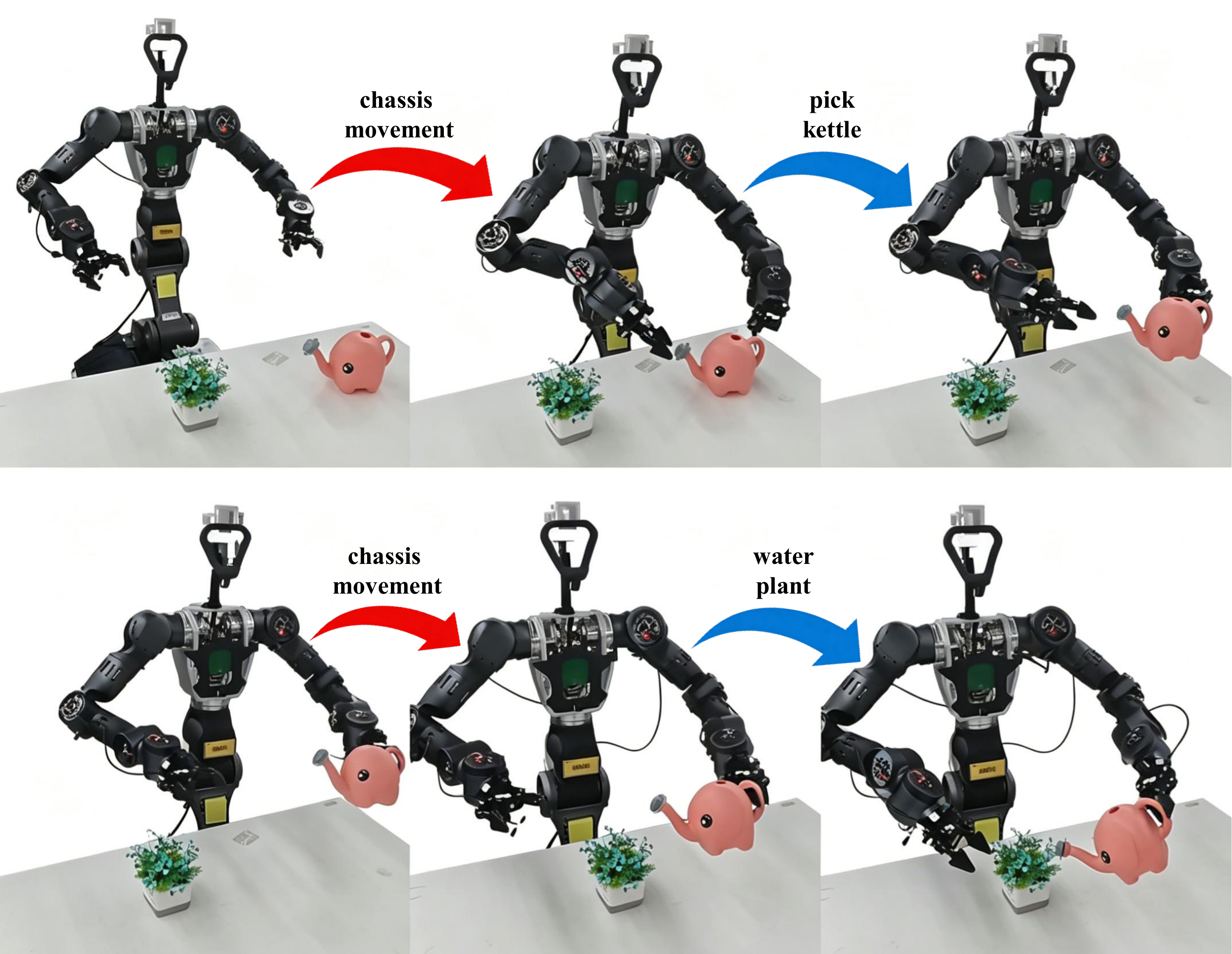
Finally, we put the three-phase pattern to the test on a held-out task the curve was never fit to: a mobile dual-arm watering task. Guided by the phase-aware rule, we collect new-hardware demonstrations only until the transfer threshold is crossed, then bring in legacy data for co-training. The result matches our prediction, with success rising from 40.0% to 78.3% while cutting new-hardware data collection from 8 hours to just 1.5 hours, offering strong validation that the pattern generalizes beyond the tasks used to derive it.
Citation
@inproceedings{wang2027legacy,
  title={When Does Legacy Data Start to Help? Emergent Transfer in Cross-Configuration Robot Learning},
  author={Wang, Tao and Hou, Hudson and Hu, Yingdong and Liu, Yufeng and Li, Qinghai and Jiang, Yingjie and Wang, Yingzhi and Ma, Cheng and Wang, Richard and Gao, Yang},
  booktitle={Proceedings of the AAAI Conference on Artificial Intelligence},
  year={2027}
}